(Download: Medistri Expands EO Infrastructure with Three New Degassing Tunnels in PDF by Medistri)
EO sterilization is a critical process that extends beyond the sterilization chamber, encompassing important considerations throughout the post-sterilization lifecycle.
While patient safety and sterilization efficacy remain the primary objectives, manufacturers must also consider how product and packaging characteristics influence EO absorption and desorption. Certain materials can absorb higher quantities of EO during sterilization and progressively release it afterward. For products or packaging systems with high EO absorbency, an adapted post-sterilization strategy may therefore be required. A no-EO cycle followed by controlled degassing helps actively remove absorbed EO under controlled conditions, significantly minimizing potential risks associated with residual EO before product release.
As regulatory expectations continue to evolve and manufacturers seek to reduce both residual levels and product release times, controlled degassing strategies are becoming an increasingly important component of EO sterilization programs.
EO Degassing Cycles provide a structured approach to accelerating residual reduction while supporting product safety, operational efficiency, and long-term compliance objectives.
What Is an EO Degassing Cycle?
An EO Degassing Cycle is an additional post-sterilization treatment designed to accelerate the removal of residual EO from products and packaging systems. The objective is to support faster residual reduction while maintaining product quality and compliance with applicable standards.
By creating controlled environmental conditions immediately after sterilization, degassing cycles help facilitate the release of absorbed EO before products enter storage, distribution, or final use.
Why Is Degassing Important?
Residual EO management remains a critical aspect of EO sterilization. Effective degassing can help manufacturers:
- Reduce residual EO levels
- Improve worker safety
- Support patient safety
- Reduce overall aeration times
- Accelerate product release
- Improve supply chain efficiency
As manufacturers seek faster market access and more sustainable sterilization strategies, controlled degassing solutions are becoming increasingly important.
Which Standards Apply?
EO degassing activities are performed within the overall EO sterilization framework. Applicable requirements may include:
- ISO 11135
- Residual evaluation requirements
- Product-specific qualification studies
- Applicable regulatory expectations
Residual testing may also be performed when required to demonstrate compliance with applicable limits and customer specifications.
Degassing as Part of a Broader Residual Management Strategy
Residual management is increasingly being viewed as a lifecycle consideration rather than a single post-sterilization activity. By accelerating the initial reduction of residual EO immediately after sterilization, dedicated degassing solutions can support a more controlled post-sterilization profile and contribute to broader residual management strategies across the supply chain.
How Does the Process Work?
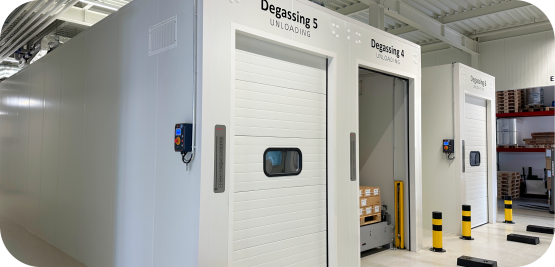
Medistri has invested in dedicated degassing tunnel infrastructure integrated with its sterilization chambers. These tunnels operate using:
- Continuous airflow
- Controlled temperature conditions
- Approximately 47°C operating temperature
- Direct integration with sterilization operations
The elevated temperature and continuous air circulation help accelerate EO desorption from products and packaging materials. Because the tunnels are directly connected to the sterilization workflow, products can move smoothly from sterilization to controlled degassing without unnecessary handling.
This integrated approach helps reduce residual levels more efficiently while supporting optimized product release timelines, while it can also be applied to all healthcare products.
Why Choose Medistri?
Medistri's degassing tunnel infrastructure forms part of a broader EO lifecycle approach. Combined with sustainable cycle development, residual testing capabilities, and expertise in post-sterilization EO behavior, Medistri helps manufacturers manage EO not only during sterilization, but throughout the entire post-processing journey.
From cycle optimization and degassing to residual evaluation and supply chain assessments, Medistri supports healthcare companies seeking a more comprehensive approach to EO management.
As sustainability, regulatory expectations, and supply chain considerations continue to evolve, degassing cycles represent an increasingly valuable tool for reducing residual EO while supporting efficient product commercialization.
To learn more about Medistri’s EO Services, please visit our website here or contact us at contact@medistri.swiss.
– The Medistri Team
#Medistri