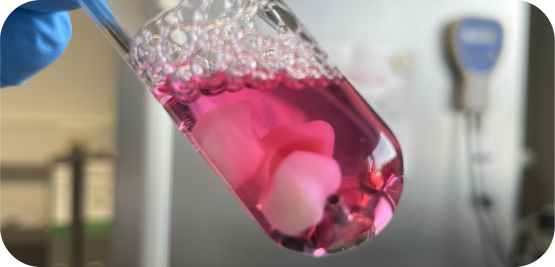
For nearly all medical devices, three biological endpoints form the foundation of a biological safety evaluation under ISO 10993-1: cytotoxicity, irritation, and sensitization. Commonly referred to as the “Big Three,” these endpoints are applicable across virtually all device categories, regardless of the nature or duration of patient contact. At Medistri, manufacturers are supported across these three endpoints through a combination of in-house in vitro testing and coordinated in vivo studies, ensuring that biological safety is demonstrated with scientific rigor and aligned with regulatory expectations.
A Foundational Role in Biological Evaluation
ISO 10993-1 structures biological evaluation according to contact type and exposure duration, assigning relevant endpoints to each category. Cytotoxicity, irritation, and sensitization remain distinct in that they apply across nearly all device types — from short-term contact with intact skin to long-term implantable devices.
These endpoints address fundamental biological risks: direct cellular toxicity, local tissue response, and the potential for allergic reaction. As a result, they systematically form the starting point of a biological evaluation programme and are among the most frequently required assessments for medical device extracts.
Cytotoxicity — ISO 10993-5
Cytotoxicity testing evaluates the potential of a material to induce toxic effects on cellular structures, identifying cellular damage or death that may translate into adverse clinical outcomes. At Medistri, cytotoxicity testing is performed in-house using both qualitative methods (Agar Diffusion Test, Direct Contact Test) and the quantitative XTT assay. These methods are conducted in accordance with ISO 10993-5 for biological evaluation and ISO 10993-12 for extraction conditions. Alignment with the FDA’s Biocompatibility Guidance on the use of ISO 10993-1 ensures that generated data meets expectations across major regulatory frameworks.
For a detailed overview of this endpoint, refer to the blog article An Overview of Cytotoxicity Analysis (February 2025).
Irritation — ISO 10993-23
Irritation testing assesses the potential of a device or its extracts to induce a localized inflammatory response in tissues that come into contact with the device, including skin, mucosal membranes, and internal tissues. ISO 10993-23 recommends the use of in vitro methods as a first-tier approach where scientifically justified, in line with the 3R principle (Replace, Reduce, Refine).
In vitro skin irritation testing
Medistri has implemented the EpiDerm™ (MatTek) Reconstructed Human Epidermis (RHE) model as a validated alternative to traditional in vivo methods for skin irritation assessment. This model consists of normal human keratinocytes cultured at the air-liquid interface, forming a stratified epidermis with a functional stratum corneum representative of native human skin. Once mature, tissues are exposed either to chemical substances (Skin Irritation Test — 24-hour exposure) or medical device extracts (18-hour exposure). Cell viability is subsequently measured using the MTT assay, where metabolically active cells convert the MTT reagent into a measurable formazan product. A viability of ≤ 50% classifies the test substance as an irritant (Category 1 or 2). This method is aligned with OECD Test Guideline 439 and ISO 10993-23, typically providing results within approximately one week. Compared to in vivo approaches, it offers reduced timelines, scalability, and full alignment with the 3R principle.
Further scientific details are available in the whitepaper In Vitro Skin Irritation Assay: A Powerful Tool for Skin Irritation of Chemical Compounds and Medical Device Extract (Q1 2025).
In vivo irritation testing
Where required by device characteristics, clinical application, or regulatory pathways, in vivo irritation studies (intracutaneous or skin irritation) are coordinated through qualified partner laboratories. Study design, extraction parameters, and reporting are aligned with the overall biological evaluation strategy.
Sensitization — ISO 10993-10
Sensitization testing determines whether a device or its extracts may induce a delayed-type hypersensitivity reaction following repeated exposure. Unlike irritation, sensitization involves an immune response that may develop over time. Clinically, this reaction is associated with contact dermatitis, with more than 4,000 contact allergens identified to date. In accordance with ISO 10993-10, sensitization is typically assessed through in vivo methods, most commonly the Local Lymph Node Assay (LLNA) or the Guinea Pig Maximization Test (GPMT). The selected approach depends on the device characteristics, extraction vehicle, and clinical route of exposure.
Medistri coordinates these studies through qualified partner laboratories, ensuring full integration of study design and reporting within the overall biological evaluation framework.
An Integrated Biological Evaluation Strategy
The value of these three endpoints extends beyond individual test results. Cytotoxicity, irritation, and sensitization form integral components of a broader biological evaluation, contributing directly to the Biological Evaluation Report (BER). Their interpretation requires alignment with chemical characterization data, clinical use, and the overall risk profile of the device.
Medistri supports manufacturers throughout this process, from the development of the Biological Evaluation Plan (BEP) and extraction strategy under ISO 10993-12, to in-house in vitro testing and coordinated in vivo studies. Final reporting is structured in accordance with ISO 10993-1:2025 requirements.
For further insight into the 2025 revision and its impact on chemical characterization and extractables & leachables (E&L) programmes, refer to the article ISO 10993-1:2025: Changes for Your Chemical Characterization and E&L Program (March 2026).
By combining in-house expertise in cytotoxicity and in vitro skin irritation with a network of qualified partners for in vivo studies, Medistri provides a structured and integrated pathway across the primary biological safety endpoints. This approach supports efficient study execution, reduces complexity, and ensures alignment with regulatory expectations.
Learn more about our Laboratory Services on our website here or contact our team at contact@medistri.com.
— The Medistri Team
#Medistri
Medistri is Europe's leading independent contract sterilization company, founded in 2006 and headquartered in the heart of Switzerland. We are a global player providing essential infrastructure that powers healthcare innovation worldwide.
We serve customers of all sizes, from startups, university projects, and research institutes to Fortune 500 corporations, across Medical Devices, Pharmaceutical Packaging, and Biotech.
Medistri supports products at every stage of the lifecycle: pre-clinical development, go-to-market, and full industrialization.
Our fully integrated, end-to-end in-house solution allows our customers to focus on what matters most: engineering, innovation, and development, while we manage the critical back-end processes.
Our synchronized departments work together to provide a complete stack of services:
- Contract Sterilization & Validation Services
- Contract Laboratory Services
- Contract Manufacturing Services
- Logistics Services
- Consulting Services
We help you accelerate time-to-market, reduce barriers to scale, and deliver safer, more sustainable healthcare solutions to patients around the world.
Medistri’s Solutions for Products in Pre-Clinical Phase
During the pre-clinical phase, execution is essential to validate concepts, generate reliable data, and establish a strong foundation for regulatory approval.
Medistri serves as your integrated infrastructure partner, delivering a comprehensive portfolio of in-house Solutions optimised for R&D and proof-of-concept development.
Our solutions encompass R&D treatment cycles (custom sterilisation protocols), cleaning & reprocessing, product assembly, and packaging, alongside specialised testing including biocompatibility, extractables & leachables, sterile barrier integrity, environmental conditioning, laboratory analysis development, batch release, and regulatory consulting.
This vertically integrated model minimises vendor coordination, expedites development iterations, guarantees data integrity and compliance from inception, and enables your team to prioritise core scientific and engineering advancements.
Positioning you for seamless progression to clinical trials and commercialisation.
Frequently Asked Questions