(Download: Environmental Conditioning in PDF by Medistri)
Medical devices and pharmaceutical products may encounter varying temperature and humidity conditions throughout storage, handling, and distribution. These environmental factors can influence the physical and mechanical properties of packaging materials, potentially affecting their ability to protect products during transportation.
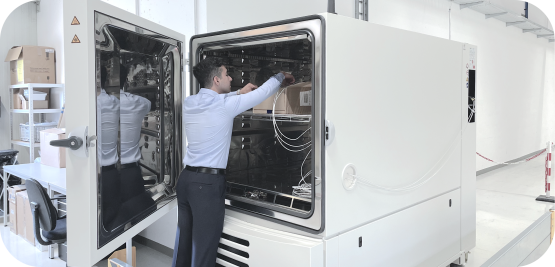
Environmental Conditioning provides a controlled method for exposing packaging systems to specified climatic conditions before subsequent testing. Performed according to ASTM D4332, this process helps manufacturers evaluate packaging behavior under defined environmental exposures and supports the development of reliable packaging validation strategies.
Understanding Environmental Conditioning and ASTM D4332
ASTM D4332, Standard Practice for Conditioning Containers, Packages, or Packaging Components for Testing, establishes procedures for conditioning packaging specimens under specified temperature and relative humidity conditions.
Packaging materials, particularly paperboard, corrugated cardboard, and certain polymers, may respond differently to climatic variations. Changes in temperature and humidity can influence mechanical strength, stiffness, dimensional stability, and other material properties.
Under ASTM D4332, packaging specimens are exposed to selected environmental conditions for an appropriate duration, allowing them to approach or reach equilibrium with the specified atmosphere. This establishes a reproducible basis for subsequent testing and helps manufacturers assess packaging performance under controlled conditions.
Environmental Conditioning is frequently incorporated into distribution simulation programs, where climatic exposure may influence packaging behavior during subsequent mechanical testing.
Environmental Conditions and Testing Profiles
ASTM D4332 defines standard and special conditioning atmospheres that can be selected according to the packaging materials, anticipated distribution environment, and testing objectives. The following table presents examples of environmental conditions used in conditioning protocols:
| Environmental Condition | Temperature (°C, °F) | Relative Humidity (%RH) |
|---|---|---|
| Extreme cold | -30 ± 2 (-22 ± 4) | Uncontrolled |
| Frozen | -18 ± 2 (0 ± 4) | Uncontrolled |
| Refrigerated | 5 ± 2 (41 ± 4) | 85 ± 5 |
| Temperature, high humidity | 20 ± 2 (68 ± 4) | 90 ± 5 |
| Tropical | 40 ± 2 (104 ± 4) | 90 ± 5 |
| Desert | 60 ± 2 (140 ± 4) | 15 ± 5 |
These controlled exposures allow manufacturers to investigate how packaging materials respond to different climatic stresses. For example, high humidity may reduce the compression resistance of corrugated packaging, while temperature variations can influence the flexibility or stiffness of certain polymer-based components. The selection of conditioning parameters and exposure duration should be justified according to the intended testing protocol.
Environmental Conditioning does not necessarily reproduce actual field conditions precisely but provides standardized exposures for evaluating packaging performance.
Environmental Conditioning in Packaging Validation
Environmental Conditioning can be integrated into broader packaging validation and distribution simulation programs. ASTM D4169, Standard Practice for Performance Testing of Shipping Containers and Systems, establishes procedures for evaluating packaging performance under distribution hazards, including vibration, compression, and shock.
When combined with ASTM D4169, Environmental Conditioning allows packaging specimens to undergo defined climatic exposure before selected mechanical tests. This helps manufacturers identify potential weaknesses in packaging materials or configurations that could affect performance during transportation.
For terminally sterilized medical devices, Environmental Conditioning may also support packaging validation activities aligned with ISO 11607-1:2019, including Amendment 1:2023 concerning the application of risk management.
While conditioning alone does not demonstrate packaging integrity or regulatory compliance, it provides supporting evidence within a broader testing strategy that may include distribution simulation, seal strength, and package integrity testing.
Supporting Packaging Performance Throughout Distribution
Environmental Conditioning helps manufacturers understand how temperature and humidity can influence packaging behavior under controlled testing conditions.
By integrating climatic exposure into packaging testing programs, manufacturers can assess material performance, identify potential vulnerabilities, and support packaging design and validation decisions.
At Medistri, Environmental Conditioning forms part of our packaging testing capabilities, supporting healthcare manufacturers in evaluating packaging performance under specified environmental conditions.
To learn more about Medistri’s Environmental Conditioning, visit our website here or contact us at contact@medistri.com.
— The Medistri Team
Medistri is Europe's leading independent contract sterilization company, founded in 2006 and headquartered in the heart of Switzerland. We are a global player providing essential infrastructure that powers healthcare innovation worldwide.
We serve customers of all sizes, from startups, university projects, and research institutes to Fortune 500 corporations, across Medical Devices, Pharmaceutical Packaging, and Biotech.
Medistri supports products at every stage of the lifecycle: pre-clinical development, go-to-market, and full industrialization.
Our fully integrated, end-to-end in-house solution allows our customers to focus on what matters most: engineering, innovation, and development, while we manage the critical back-end processes.
Our synchronized departments work together to provide a complete stack of services:
- Contract Sterilization & Validation Services
- Contract Laboratory Services
- Contract Manufacturing Services
- Logistics Services
- Consulting Services
We help you accelerate time-to-market, reduce barriers to scale, and deliver safer, more sustainable healthcare solutions to patients around the world.
Medistri’s Solutions for Products in Pre-Clinical Phase
During the pre-clinical phase, execution is essential to validate concepts, generate reliable data, and establish a strong foundation for regulatory approval.
Medistri serves as your integrated infrastructure partner, delivering a comprehensive portfolio of in-house Solutions optimised for R&D and proof-of-concept development.
Our solutions encompass R&D treatment cycles (custom sterilisation protocols), cleaning & reprocessing, product assembly, and packaging, alongside specialised testing including biocompatibility, extractables & leachables, sterile barrier integrity, environmental conditioning, laboratory analysis development, batch release, and regulatory consulting.
This vertically integrated model minimises vendor coordination, expedites development iterations, guarantees data integrity and compliance from inception, and enables your team to prioritise core scientific and engineering advancements.
Positioning you for seamless progression to clinical trials and commercialization.
FAQ – Environmental Conditioning
1. What is Environmental Conditioning?
Environmental Conditioning is a controlled testing process that exposes packaging materials and systems to defined temperature and humidity conditions to evaluate their behavior before subsequent testing.
2. When is Environmental Conditioning required?
Environmental Conditioning is typically performed during packaging development, validation, or distribution simulation when temperature and humidity may affect packaging performance.
3. Which environmental conditions can be tested?
Depending on the product and packaging requirements, testing can include extreme cold, refrigerated conditions, high humidity, tropical climates, and desert environments, following ASTM D4332.
4. How long does Environmental Conditioning take?
The duration depends on the selected temperature and humidity conditions, packaging materials, and testing protocol. Specimens are conditioned for a defined period to achieve the required environmental exposure.
5. Can Environmental Conditioning be combined with transport simulation testing?
Yes. Medistri can integrate Environmental Conditioning with transport simulation testing according to ASTM D4169 to evaluate packaging performance following climatic exposure and mechanical stresses.